
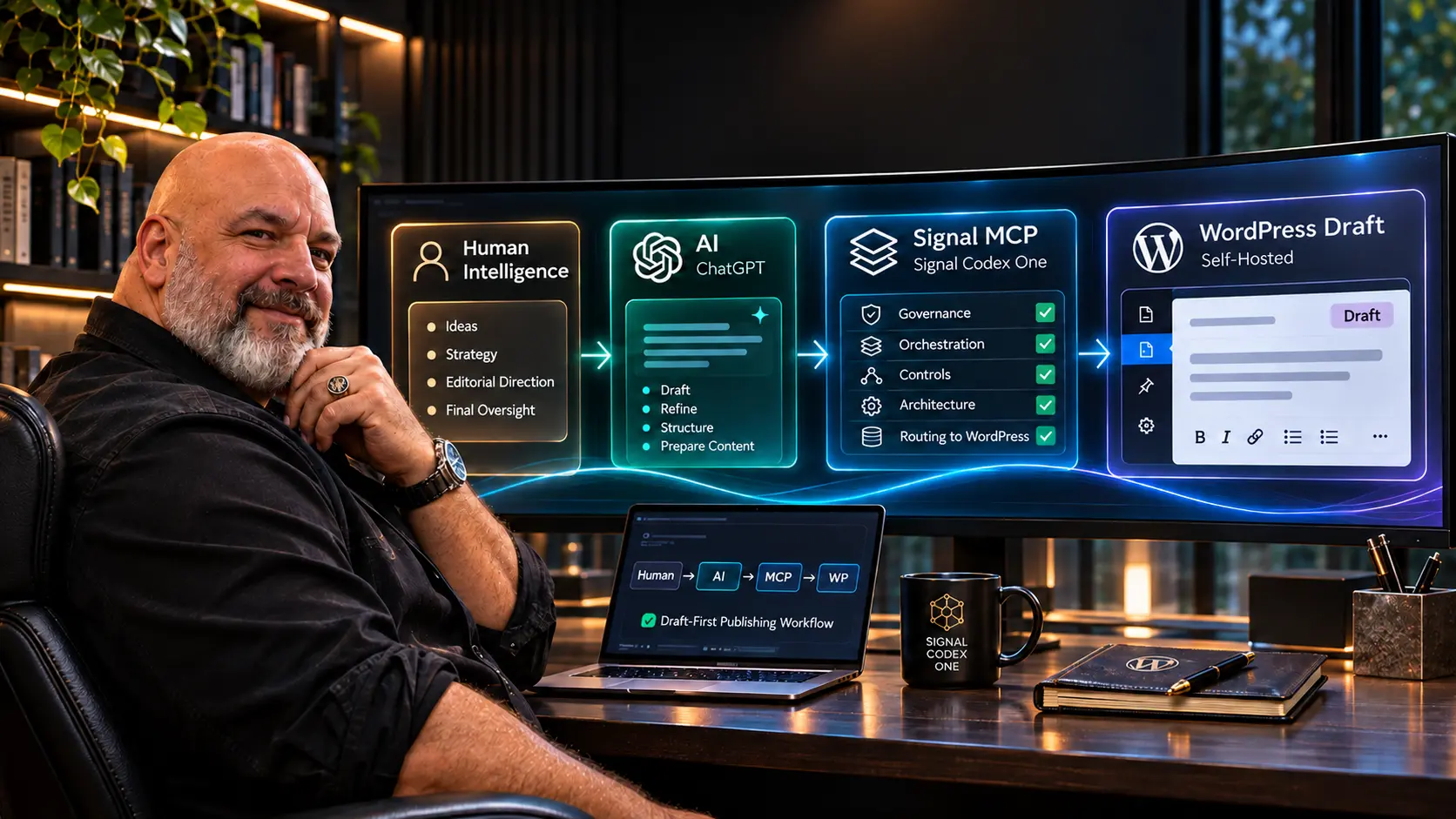
Building a Bridge Between Human Intelligence, AI, and WordPress
Today, JoelAdamski.com crossed a small but important threshold: ChatGPT and my self-hosted WordPress installation can finally work together through infrastructure I control.
It might look like a simple publishing integration. To me, it represents something bigger: another piece of a human-governed AI ecosystem moving from concept into operation.
Part 01 — Why Build the Bridge?
I like WordPress. It is familiar, flexible, and already does an excellent job of managing content. I did not need to replace it. I needed a better way to work with it.
The obvious route was a third-party AI writing connector. But another subscription, another usage limit, and another dependency sitting between me and a website I own made very little architectural sense.
We already had a working MCP connection inside Signal Codex One. It could authenticate ChatGPT, enforce workspace boundaries, manage drafts, and record activity. Building another server would have duplicated a system we had already invested in.
So the decision was straightforward: extend Signal instead of adding a middleman. WordPress remains the content management system. ChatGPT helps with writing and reasoning. Signal Codex One becomes the governed connection between them.
Part 02 — From Architecture to a Working Connection
We added a WordPress integration to Signal’s existing PHP application and MCP endpoint. The first set of tools is deliberately narrow: list posts, read an individual post, list categories, create a draft, and update an existing draft.
The WordPress side uses a dedicated account and an Application Password over HTTPS. The credential stays in Signal’s private server configuration. It is not stored in the GitHub repository, exposed in the conversation, or returned by the MCP tools.
Just as important, WordPress access requires a separate OAuth authorization. An existing Signal connection does not automatically gain permission to reach another system. Reading and writing drafts have their own capability checks, and publishing is intentionally excluded.
We built the changes in the private Signal repository, reviewed them through pull request #18, and merged them after the automated regression checks passed. Then we configured the connection on the Hostinger server.
The live read-only test worked. ChatGPT retrieved the site’s existing “Hello world!” post and its Uncategorized category through Signal. No WordPress dashboard session, copied login password, or paid writing connector was required.
And this Field Notes entry is the next test: a real article saved from ChatGPT into WordPress as an unpublished draft. The human still makes the publication decision.
Part 03 — What This Makes Possible
The important achievement is not that an AI can put words in a database. That has been technically possible for years. The achievement is defining who can do what, through which system, with which credentials, and with a deliberate stopping point before publication.
My working model has always been that human activity produces narratives, narratives generate signals, signals become knowledge, and AI can use that knowledge to assist the next human decision. This bridge gives that model a practical editorial pathway.
The next phase is to develop it into a repeatable Field Notes workflow: gather the day’s meaningful work, identify decisions and lessons, shape the story into readable sections, save a WordPress draft, and leave the final editorial review with me.
Later, Signal can support additional WordPress sites, distinct workspace permissions, media handling, editorial metadata, and more structured review workflows. But those features should follow demonstrated needs—not precede them.
For now, the rule stays simple: AI can assist and prepare. Humans retain authority to approve and publish.
One small bridge. One less dependency. One more piece of the ecosystem actually working.
— Joel Adamski
Leave a Reply